Form 16 from a previous employer: how to get it, and what to do if they don't send it
How to get Form 16 from your previous employer, when it is issued, how to file your ITR with two employers, what to do if the company shuts down, and how Form 130 replaces Form 16 under the new Income-tax Act.
Form 16 is the document you ignore all year and then need urgently: for your tax return, for your new employer's payroll, and sometimes for a loan or visa. If you switched jobs, you need it from your previous employer, who now replies to your emails about as fast as a government office in May.
Here is how to get it, and what to do if it never comes.
What Form 16 is
Form 16 is the certificate your employer gives you for the tax (TDS) they deducted from your salary. It has two parts:
- Part A: employer and employee details, PAN and TAN, and a summary of tax deducted and deposited each quarter.
- Part B: the salary breakup, exemptions, deductions and how your tax was calculated.
Employers must issue it by 15 June after the financial year ends. Form 16 for FY 2025-26 was due by 15 June 2026, as this India Briefing explainer on the Form 16 deadline sets out.
Heads up: Form 16 becomes Form 130
The new Income-tax Act, 2025 applies from tax year 2026-27. Under it, Form 130 replaces Form 16 for salary TDS. Form 16 still covers FY 2025-26, and the first Form 130 certificates are due by 15 June 2027, according to the same India Briefing guide to the new TDS forms. If your HR team or a tax site talks about "Form 130", it is the same idea with a new name.
How to get Form 16 from a previous employer
1. Check the HR portal and your email first
Many companies upload Form 16 to their HR or payroll portal, or email it from a payroll vendor. Search your personal inbox for "Form 16", "TDS certificate" and your old company's name. If you still have portal access, download every year you can see.
2. Email HR or payroll directly
Subject: Form 16 for FY [2025-26]: [Your name], [Employee ID], PAN [XXXXX1234X]

Hi [HR / Payroll team],

I worked at [Company] from [joining date] to [last working day].
Could you please share my Form 16 (Part A and Part B) for FY [2025-26]?

I need it to file my income tax return and for my current employer's payroll.

Thanks,
[Your name]
[Phone number]
Include your PAN and employee ID. It saves a round of back and forth.
3. Follow up, then escalate
No reply in a week? Write again and copy the HR head or your former manager. Payroll teams often process these in batches, so a polite nudge usually works.
If they still don't send it: your plan B
Here is the good news. You can file your income tax return without Form 16. What you actually need is proof of your salary and the tax already deducted against your PAN. Both are available to you directly:
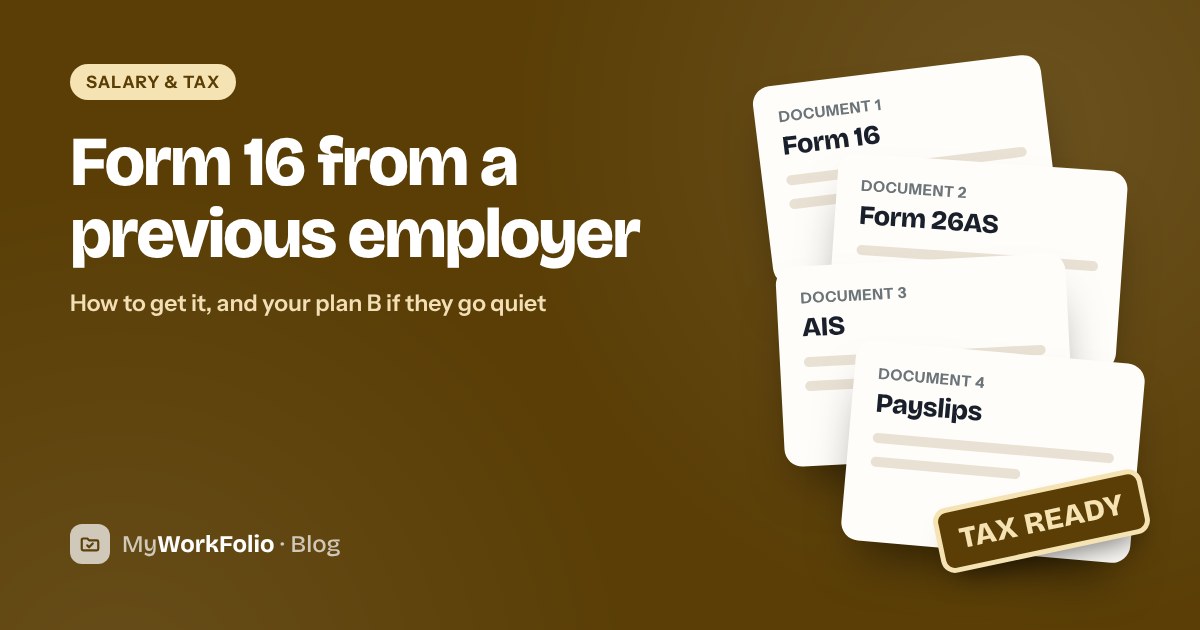
- Form 26AS: shows TDS deducted against your PAN by every deductor, including your old employer. View it from the income tax e-filing portal, which links to TRACES.
- AIS (Annual Information Statement): a wider view of your income and tax for the year, on the same portal.
- Your payslips: give you the salary breakup Part B would have shown.
If your old employer deducted tax but it does not show in Form 26AS, that is a real problem. It means the tax may not have been deposited against your PAN. Raise it with the employer in writing immediately, because you cannot claim credit for TDS that is not reflected there.
Two employers in one year: how to avoid paying the wrong tax
When you switch jobs mid-year, each employer only sees its own slice of your salary. Both may apply the basic exemption and lower tax slabs, so your total TDS can come out too low. Then you get a tax bill at filing time.
To avoid that:
- Tell your new employer about your earlier salary and TDS for the year as soon as you join, so they deduct correctly for the rest of the year. Your payroll team will tell you which declaration form they use.
- Collect Form 16 (or the new Form 130) from both employers.
- When filing, add up the income and TDS from both. Check the totals against Form 26AS and AIS before you submit.
If you are also negotiating your package, keeping your Form 16 and payslips together helps show your current salary quickly. It is one of the first things on the list of documents required for joining a new job.
If your old company shut down or was acquired
- Acquired: the acquiring company usually takes over payroll records. Write to their HR with your old employee ID.
- Shut down: rely on Form 26AS, AIS and your payslips. This is exactly why keeping your own copies matters. If you were let go as part of a layoff, here is what else to secure: laid off? what to do next.
Keep every Form 16, every year
You will need old ones more often than you think: home loan applications, visa paperwork, income proof for a rental, or a tax notice for a year you have long forgotten. Store each year's Form 16 or Form 130 next to that year's payslips.
MyWorkFolio does this automatically: one folder per employer, payslips and tax documents together, and a reminder when Form 16 season comes around.
Frequently asked questions
When does an employer issue Form 16?
Employers must issue Form 16 for a financial year by 15 June of the following year. For example, Form 16 for FY 2025-26 was due by 15 June 2026.
Can I file my ITR without Form 16?
Yes. Form 16 makes filing easier, but it is not mandatory. You can use your payslips together with Form 26AS and the Annual Information Statement (AIS) on the income tax e-filing portal, which show the tax deducted against your PAN.
Do I need Form 16 from both employers if I switched jobs?
Yes, ideally. Each employer issues Form 16 for the period you worked there. When filing, you add up the salary and TDS from both so your total income and tax are correct.
What is Form 130?
Under the Income-tax Act, 2025, Form 130 replaces Form 16 as the salary TDS certificate, starting with tax year 2026-27. Form 16 still applies to FY 2025-26.
This article is general information, not legal or tax advice. Rules change, so check the official sources linked above for your situation.