Documents required for joining a new job in India: the complete checklist
The full list of documents HR asks for when you join a new company in India: ID, education, previous employment, salary proof, PF and tax. Plus where to find each one fast.
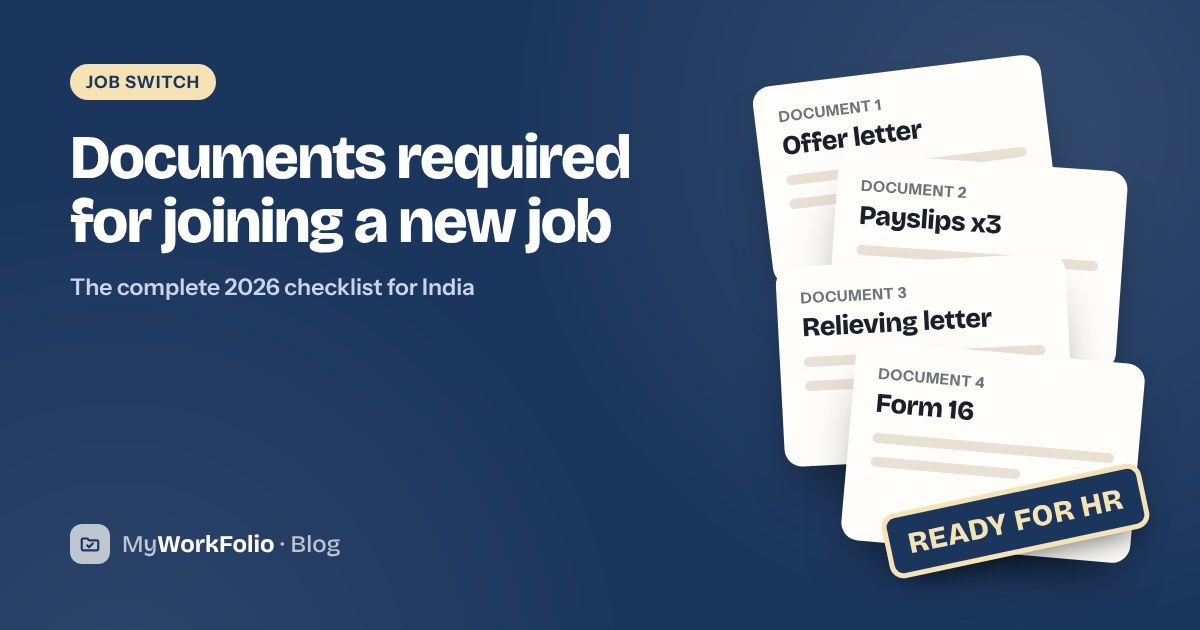
You got the offer. Congratulations. Now HR sends the email that ruins the weekend: "Please share the following documents before your joining date."
This is the list that usually follows, grouped the way HR teams actually check it. Exact lists vary by company, so treat your new employer's email as final. But if you have everything below ready, you will not be the person digging through Gmail page 7 at midnight.
The quick checklist
| Group | Documents | Where it usually hides |
|---|---|---|
| Identity | PAN, Aadhaar, passport (if you have one), passport size photos | Your wallet, DigiLocker |
| Education | 10th and 12th marksheets, degree certificate, final year marksheets or consolidated transcript | A file at your parents' place, DigiLocker for some boards and universities |
| Previous employment | Offer and appointment letters, relieving letter, experience letter | Old work email (if you still have access), personal Gmail |
| Salary proof | Last 3 payslips, current or last Form 16, sometimes bank statements | HR portal of your old company, your inbox |
| PF and tax | UAN, previous employer's PF member ID, salary and TDS details from earlier in the year | Your payslip, the EPFO member portal |
| Bank and personal | Cancelled cheque or bank details, address proof, emergency contact | Your bank app |
| Joining forms | Signed offer letter, NDA, nomination forms for PF and gratuity | The new company's onboarding portal |
1. Identity documents
PAN and Aadhaar are non-negotiable because payroll and PF both run on them. Keep clear scans of both sides, and make sure the name on each matches exactly. A missing middle name is the most common reason a background check comes back with a mismatch.
If you have a passport, keep a copy ready. Some companies use it as address proof, and you will need it anyway if the role involves travel.
2. Education certificates
Expect to share your 10th and 12th marksheets, your degree certificate and either final year marksheets or a consolidated transcript. If your degree certificate has not been issued yet, a provisional certificate usually works for now.
Many boards and universities now push certificates to DigiLocker, which counts as a valid digital copy in a lot of HR processes. Check there before you start a hunt through old files.
3. Documents from your previous employer
This is where most people get stuck, because these depend on someone else.
- Offer letter and appointment letter from your last job. These prove when you joined and what role you held. Not sure which is which? See offer letter vs appointment letter.
- Relieving letter, which confirms you left properly and served or settled your notice. If you are unsure how it differs from an experience letter, read our guide on the relieving letter vs experience letter.
- Experience letter or service certificate, which confirms your role and tenure.
If your last day was only days ago, the relieving letter may not be ready yet. Share your resignation acceptance email with your new HR as interim proof and tell them when you expect the letter.
4. Salary proof
Most companies ask for the last three months of payslips. If the lines on them confuse you, here are salary slip components explained. Some also ask for your Form 16 from your last full financial year, to confirm your salary and the tax already deducted.
Changing jobs in the middle of a financial year means your new employer needs your salary and TDS details from the old one, so tax is calculated correctly for the full year. Our Form 16 from a previous employer guide covers how to get it and what to do if the old company goes quiet.
5. PF and UAN
Your UAN (Universal Account Number) stays with you for life. Give it to your new employer so your PF continues on the same account instead of a new one being opened. You will find it on your payslip or by logging into the EPFO member portal.
Two UANs is a common mess and a common background check flag. If you have ended up with two, raise it early. After joining, move your old balance to the new account; EPFO now lets you start a PF transfer online after a job change using your UAN and an Aadhaar OTP.
6. Background verification documents
Most mid-size and large companies run a background check (BGV) after you accept. It usually re-checks your identity, education and employment history, and needs your signed consent. The documents overlap heavily with the list above, but the check is stricter about dates and designations matching. See our full guide to background verification documents before you fill the BGV form.
How to find everything fast
- Search your inbox by sender, not subject. Search your old employer's HR or payroll domain. Payslips often arrive from a payroll vendor, so also search "payslip", "salary slip" and "pay slip".
- Check your old company's HR portal now. Access usually ends after your last working day. Download every payslip and your Form 16 while you still can.
- Ask for a soft copy of everything on your last day. It is much harder to get documents once you are an alumnus emailing a generic HR inbox.
- Keep one folder for all of it. Not ten folders across three devices.
That last step is why we built MyWorkFolio. It keeps every career document in one private vault and builds the exact joining pack HR asks for, so the next time this email arrives you send it in a minute.
Bottom line
The documents that slow you down are never the ones in your wallet. They are the ones that depend on your old employer: relieving letter, payslips and Form 16. Get those on your last day, store them in one place, and your joining week becomes a lot less dramatic.
If you are still deciding whether to make the move at all, start with when to switch jobs.
Frequently asked questions
What documents are required for joining a new company in India?
Usually: PAN and Aadhaar, passport size photos, education certificates and marksheets, the signed offer letter, your previous company's relieving and experience letters, the last three months of payslips, Form 16 or your current year's salary details, your UAN for PF, and a cancelled cheque or bank details.
Can I join a new job without a relieving letter?
Many companies let you join and submit the relieving letter later, but some make your joining or your background check conditional on it. Tell your new HR early, share your resignation acceptance email as interim proof, and keep chasing the old employer in writing.
How many payslips do I need for a new job?
Most companies ask for the last three months. Some ask for six, especially when your new salary is a big jump or for senior roles.