Background verification (BGV) in India: documents needed and why checks fail
What a background verification (BGV) checks in India, the documents you need, how long it takes, and the common mismatches that make a BGV fail, so you can fix them before you submit.
You accepted the offer. Then an email arrives from a verification agency asking you to upload a dozen documents and fill a long form about every job you have ever had. Welcome to background verification, or BGV.
It is routine at most mid-size and large companies in India. Most people pass without drama. The ones who struggle usually have a small mismatch they did not notice. Here is how to avoid being one of them.
What a background verification checks
| Check | What they verify | Documents you will need |
|---|---|---|
| Identity | You are who you say you are | PAN, Aadhaar, passport, photo |
| Address | Current and sometimes permanent address | Address proof, sometimes a physical or digital visit |
| Education | Your highest degree is genuine | Degree certificate, final marksheets, university details |
| Employment | Each past job: dates, designation, reason for leaving | Offer letters, relieving and experience letters, payslips |
| PF history | Which employers paid into your PF and when | UAN |
| Criminal record | No relevant court or police records | Consent form, address history |
| References | What former managers say about you | Names and contact details you provide |
Some roles add credit checks (common in banking and finance) or social media and directorship checks for senior positions. You will sign a consent form before any of it starts, since these checks involve your personal data.
Documents to keep ready
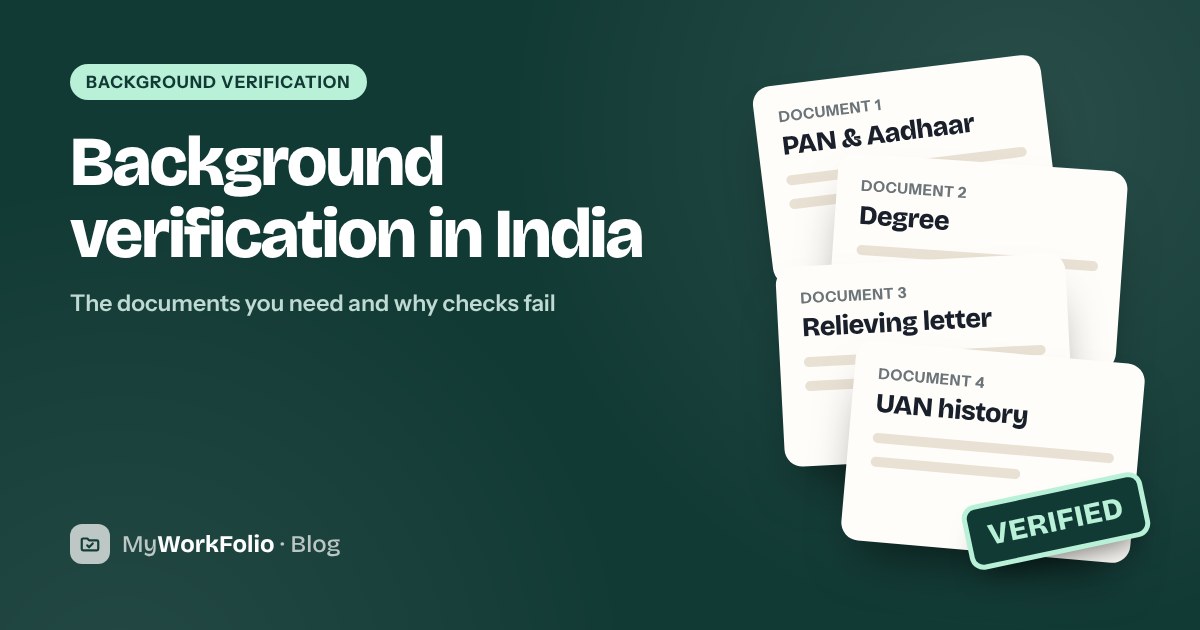
The BGV list overlaps almost entirely with the documents required for joining a new job. The difference is that the agency compares them against each other and against what your past employers say. Keep these together:
- PAN and Aadhaar, with your name spelled the same way on both. UIDAI lets you update Aadhaar details if needed.
- Degree certificate and final marksheets. DigiLocker often has verified copies.
- For every past employer: offer letter, relieving letter and experience letter, and a few payslips.
- Your UAN. Check your own service history first on the EPFO member portal so nothing surprises you.
- Reference contacts. Ask your references before you list them. A surprised reference is a weak reference.
The 7 mismatches that get flagged most
- Dates that do not match. Your resume says you joined in June, your offer letter says July. Use the dates on your official letters everywhere.
- Designations that do not match. "Marketing Manager" on LinkedIn, "Senior Executive" on your experience letter. If you were promoted, show both titles with dates.
- An employer you left off. Short stints you would rather forget often show up in your PF history. Disclose them.
- Two UANs or overlapping PF contributions. Overlapping dates can look like dual employment. If there is an innocent reason, such as a PF transfer that was never completed, explain it upfront.
- Unexplained gaps. Gaps are normal. Hiding them is the problem. A one-line explanation (studies, family, health, a sabbatical) is usually enough. Here is how to explain an employment gap.
- Name spelling differences. Different spellings across PAN, Aadhaar and certificates trigger manual checks. Fix the source document or attach a declaration.
- A previous employer that does not respond. Not your fault, but it delays your check. Payslips, Form 16 and your relieving letter help the agency close it anyway.
How to make your BGV boring (which is the goal)
- Fill the form from your documents, not your memory. Open every letter and copy dates exactly.
- Match your resume and LinkedIn to your letters before you submit, not after HR asks.
- Upload clear, complete scans. All pages, readable, not cropped phone photos.
- Answer agency calls and emails quickly. Most delays are on the candidate's side.
- Tell HR about any known issue first. A disclosed issue is a conversation. A discovered one is a red flag.
If your BGV comes back with a discrepancy
Do not panic, and do not argue in the first email. Ask what exactly was flagged, then send documents that explain it: a corrected letter, a payslip showing the right designation, or a note explaining the gap. Most honest mismatches get resolved this way.
Bottom line
BGV is a document matching exercise. If your letters, payslips, PF history and resume all tell the same story, you pass. The hard part is having all of those in one place when the agency's email lands.
MyWorkFolio keeps every employer's letters, payslips and tax documents together, and builds a verification pack from them. It also helps to keep a running record of your work, which we cover in how to build a career portfolio.
Frequently asked questions
How long does background verification take in India?
Commonly one to three weeks. It can take longer if a previous employer or university is slow to respond, or if a check needs a physical address visit.
Can I join before my BGV is complete?
Many companies let you join while the check is in progress, with the offer conditional on a clear result. Read your offer letter for the exact condition.
Does BGV check my PF or UAN history?
Often, yes. Your UAN service history shows which employers contributed to your PF and when, which makes it easy to spot undisclosed jobs or date mismatches.
What happens if my BGV shows a discrepancy?
Usually HR asks you to explain it first. Honest, documented explanations such as a wrong date on an old letter are often resolved. Hidden employment or fake documents usually lead to the offer being withdrawn.