How to build a career portfolio that proves your work (even if you're not a designer)
A career portfolio is not just for designers. How to build a proof-of-work portfolio for marketing, product, sales, engineering or operations roles, what to include, and how to keep it updated.
Recruiters see the same resume line a hundred times a day: "Drove growth across channels." A career portfolio is how you show what that actually meant: the campaign, the dashboard, the deal, the system you built, and the number that moved.
Designers have always had portfolios. Everyone else is now catching up, because "show me" beats "trust me" in every interview.
What a career portfolio is
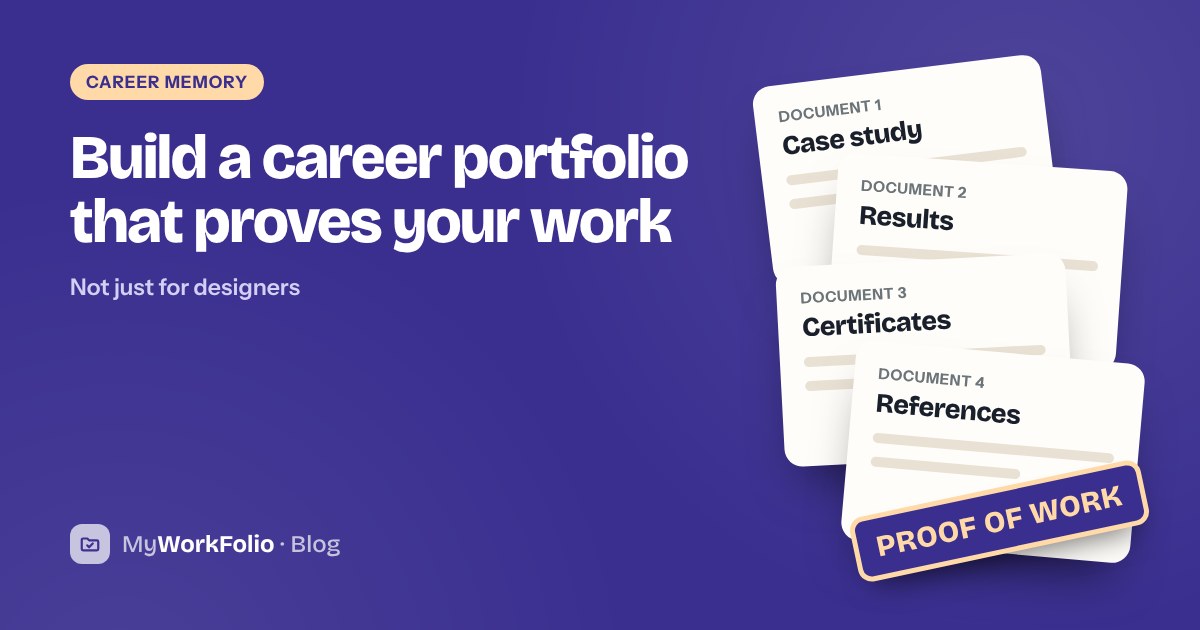
A career portfolio is a small collection of proof of your work: three to six examples of things you did, what changed because of them, and evidence that it happened.
It is different from a resume. A resume lists. A portfolio proves.
Why you need one, whatever your role
- It answers the interview question before it is asked. "Tell me about a project you're proud of" becomes "Here, let me show you."
- It supports salary negotiation. Clear results with numbers make a stronger case than years of experience.
- It survives your memory. Two years from now you will not remember the exact numbers. Your portfolio will.
- It is rare. Outside creative roles, most candidates don't have one. That alone makes you memorable.
What to include, by role
| Role | Good portfolio pieces |
|---|---|
| Marketing | Campaign case studies with spend, CAC or ROAS before and after; creative samples; a dashboard you built |
| Product | PRDs (redacted), before and after screens, an experiment with its result, a launch plan |
| Sales and business development | Deals you closed (anonymised), a pitch deck, a territory or account plan, quota attainment |
| Engineering | Repositories on GitHub, architecture diagrams, a performance or cost improvement with numbers |
| Design | Projects on Behance or your own site, with the problem and your process, not just final screens |
| Operations and finance | A process you redesigned, time or money saved, a model or report you built |
Redact everything confidential. Client names, internal numbers and screenshots of internal tools can get you into trouble. Use percentages instead of absolute revenue, and blur names.
The structure of one case study
Keep every piece the same shape, so a recruiter can skim it in a minute:
- Context. One or two lines: the company type, your role, the team size.
- Problem. What was broken or what needed to happen.
- What you did. Your actions, not the team's. Use "I".
- Result. Numbers first: "Cut cost per lead 32% in 8 weeks." If you cannot share numbers, describe the outcome.
- Proof. A screenshot, a link, an award, or a line of feedback from a manager or client.
Where to put it
You do not need a fancy website. Any of these works:
- A one-page website with a simple builder
- A clean PDF of 6 to 10 pages
- A shared folder with one summary document at the top
Put the link in your resume header and pin it in your LinkedIn Featured section. Keep it to one link. Nobody clicks five.
The real problem: keeping it updated
Most portfolios are built once, the week before a job hunt, from fading memory. The fix is to capture proof as you go:
- Save the screenshot the day the result comes in
- Forward the "great work" email to yourself
- Download the certificate the day you finish the course
- Write a two-line note after every project
That running record is called a brag document, and it is the raw material for both your portfolio and your appraisal. Here is our guide on how to keep a brag document for appraisals.
Your documents are part of your proof
Your work samples show what you can do. Your offer letters, relieving letters, promotion letters, payslips and certificates prove where and when you did it. Recruiters check both, especially during background verification.
MyWorkFolio keeps both in one private vault: your career documents sorted by employer, and your proof of work alongside them. When someone asks to see your portfolio, or HR asks for your documents, it is all one click away.
Bottom line
A portfolio is the easiest edge you can build this month. Pick your three best projects, write them up in the five-part structure, and start saving proof from today. And if AI is changing what your role looks like, a portfolio of results is exactly what keeps you hireable. Read more in our guide to AI and jobs in India.
Frequently asked questions
What should a career portfolio include?
Three to six case studies of your best work, each with the problem, what you did, and the result in numbers. Add proof such as screenshots, links, certificates, awards and short quotes from managers or clients.
Do I need a portfolio if I'm not a designer?
It helps more than you might expect. Marketers, product managers, analysts, salespeople and engineers can all show work samples and results. Most candidates in these roles don't, so it makes you stand out.
How do I share my portfolio with recruiters?
A single link works best: a simple web page, a PDF, or a public folder. Put it in your resume header and your LinkedIn Featured section. Remove anything confidential first.