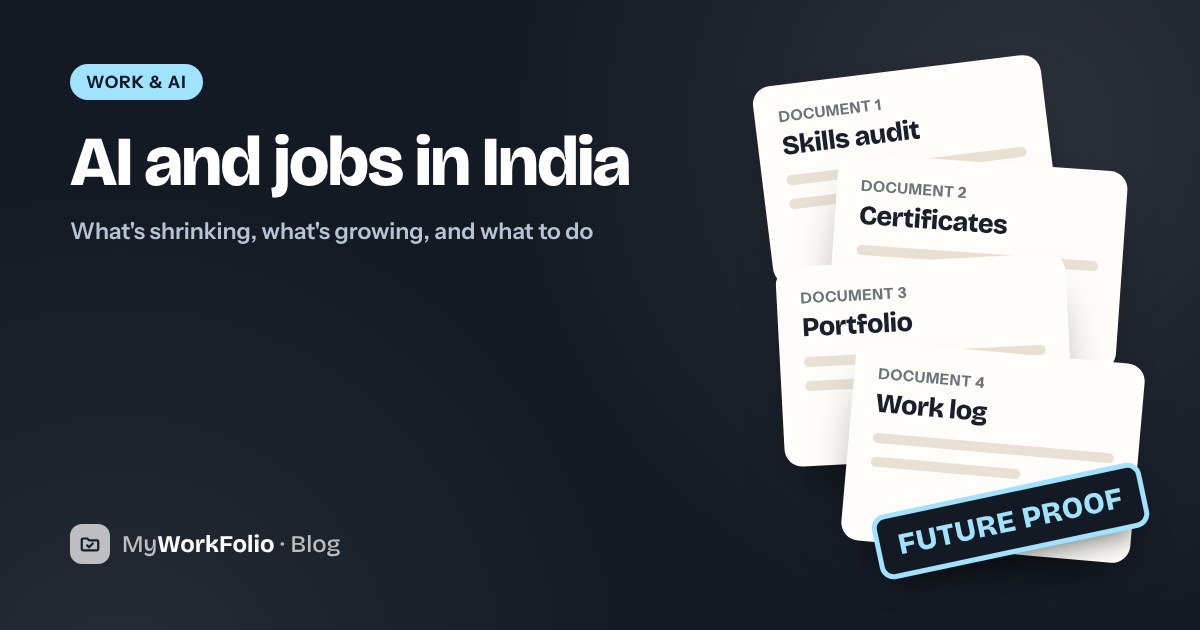
AI and jobs in India: which roles are shrinking, which are growing, and how to stay hireable
What the data says about AI and jobs: the roles expected to decline, the fastest-growing jobs and skills to 2030, what it means for Indian professionals, and a practical plan to stay hireable.
Every week brings a new headline: AI will take half of all jobs, AI will create millions of jobs, layoffs here, hiring sprees there. If you are a working professional in India, the honest question is simpler: what does this mean for my job, and what should I do about it?
Here is what the most widely cited data says, and a practical plan that does not require you to become a machine learning engineer.
What the data says
The World Economic Forum's Future of Jobs Report 2025, based on a survey of more than 1,000 employers across 55 economies, estimates that by 2030:
- About 170 million new jobs will be created
- About 92 million jobs will be displaced
- That is a net gain of about 78 million jobs
- Around 39% of workers' core skills are expected to change
So the story is not "jobs disappear". It is "jobs move". The risk is being in a shrinking role without the skills for a growing one. The WEF summary of the jobs of the future and the skills you need is worth ten minutes of your time.
These are global findings. India's job market has its own mix, but the direction of travel is similar for knowledge work.
Which roles are shrinking
The report expects the fastest declines in roles like:
- Postal service clerks
- Bank tellers
- Data entry clerks
In absolute numbers, the biggest decline is in clerical and secretarial work, including cashiers, ticket clerks, and administrative assistants and executive secretaries.
The pattern matters more than the list. Roles made mostly of routine, rules-based tasks (copying, checking, formatting, simple reporting) are the most exposed. That includes parts of many office jobs that are not on any list: manual reporting in marketing, first-level support, basic research, routine documentation.
Which roles are growing
The fastest-growing roles in percentage terms are mostly in technology:
- Big data specialists
- Fintech engineers
- AI and machine learning specialists
- Software and application developers
Green transition roles such as renewable energy and environmental engineers are also growing quickly. In absolute numbers, large frontline categories such as delivery drivers and construction workers grow the most.
The skills rising fastest are AI and big data, networks and cybersecurity and technological literacy, alongside creative thinking, resilience and curiosity.
What this means if you are not in tech
You do not need to switch careers to stay relevant. For most marketers, analysts, HR and finance professionals, operations managers and salespeople, the realistic shift is this:
The work stays. The way it is done changes. The person who uses AI tools to do in one hour what used to take a day becomes more valuable. The person who refuses becomes expensive.
A practical plan to stay hireable
1. Audit your own tasks
List what you do in a typical week. Mark each task as routine (could be automated), judgement (needs you) or relationship (needs a human). If most of your week is routine, start shifting now, before your company does it for you.
2. Learn the AI tools for your function
Not "learn AI" in general. Learn the specific tools your role uses: AI for analysis and reporting if you are in marketing or finance, AI for screening and drafting if you are in HR, AI coding assistants if you write code. Use them on real work and note the time saved.
3. Build proof, not just certificates
Certificates show you attended. Results show you can do it. Keep a career portfolio with before-and-after examples: "Automated weekly reporting with AI, saved 6 hours a week". That line beats any course badge.
4. Track your wins as you go
A running brag document makes your impact visible at appraisal time, which matters more when companies are deciding which roles to keep.
5. Time your move on your terms
If your role is clearly shrinking, the best time to move is before a restructuring, not after. Read when to switch jobs for the signs and a pre-resignation checklist. If it has already happened, here is what to do after a layoff.
6. Keep your records portable
Moves happen faster now. Have your payslips, letters, Form 16 and certificates ready so a sudden opportunity, or a sudden exit, does not turn into a document scramble.
Bottom line
The data points to a big reshuffle, not an apocalypse. The professionals who do well will be the ones who use the tools, can prove their results, and are ready to move when the moment comes.
MyWorkFolio helps with the last part: every career document and every piece of proof in one private vault, so you are always ready for the next opportunity.
Frequently asked questions
Will AI take my job?
For most roles, AI changes the tasks inside the job before it removes the job. Roles made mostly of routine, rules-based tasks such as data entry are most exposed. The safest position is being the person in your team who uses AI tools well and can show the results.
Which jobs are growing fastest because of AI and technology?
According to the World Economic Forum's Future of Jobs Report 2025, the fastest-growing roles in percentage terms include big data specialists, fintech engineers, AI and machine learning specialists, and software and application developers.
Which jobs are declining the fastest?
The same report expects the fastest declines in roles like postal service clerks, bank tellers and data entry clerks, with the largest absolute decline among clerical and secretarial workers such as cashiers, ticket clerks and administrative assistants.