Relieving letter vs experience letter: the difference, and what to do if yours is delayed
What a relieving letter and an experience letter are, why your new employer wants both, what they should say, and a polite email template to request one that is delayed.
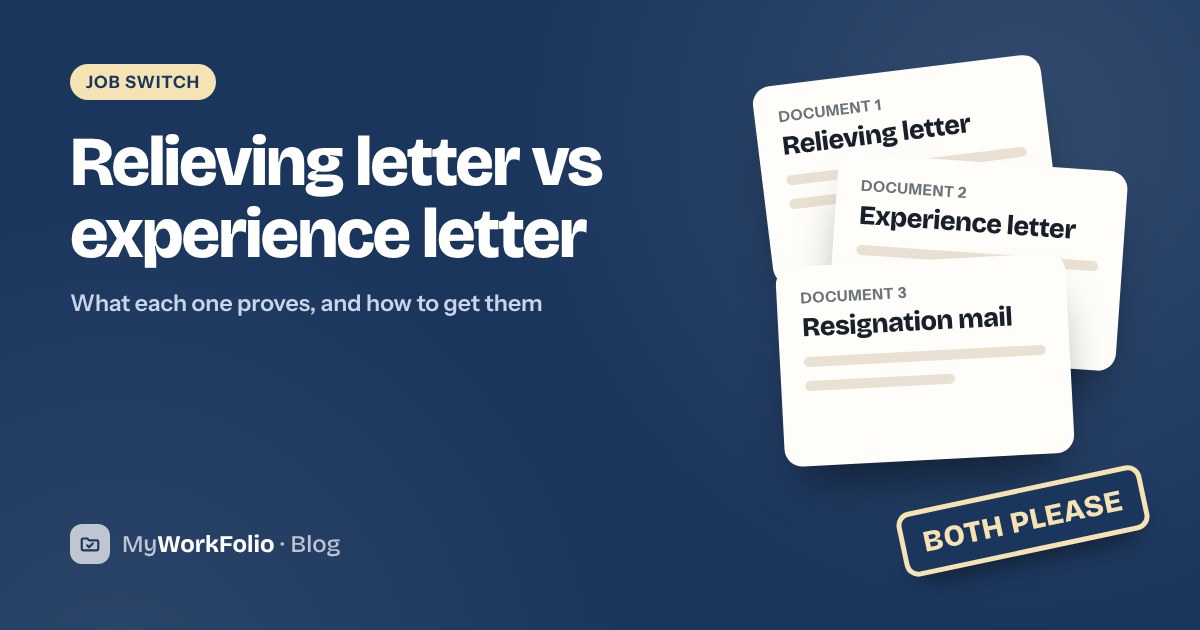
Two letters cause more joining-week panic than anything else: the relieving letter and the experience letter. People mix them up, companies sometimes combine them, and your new HR team usually wants both.
Here is what each one is, what it should say, and what to do when yours is late.
The difference in one table
| Relieving letter | Experience letter | |
|---|---|---|
| What it proves | You resigned and were formally released | You worked there, for how long, in what role |
| When you get it | On or after your last working day | Often with the relieving letter, sometimes on request |
| Who asks for it | Your new employer, background verification agencies | New employers, visa and higher studies applications |
| Key details | Resignation date, last working day, confirmation you are relieved | Joining date, last working day, designation, sometimes a line on conduct |
Some companies issue a single "relieving cum experience letter". That is fine, as long as it covers everything in both columns.
What a relieving letter should say
Check yours for these before you leave the building:
- Your full name exactly as on your PAN, and your employee ID
- Your designation and department
- Your date of joining, resignation date and last working day
- A clear line that you have been relieved of your duties
- Company letterhead, an authorised signatory's name and signature, and the date
A wrong last working day or a designation that does not match your payslips is a common reason a background verification comes back with a discrepancy. Get errors fixed while you still know who to ask.
What an experience letter should say
- Your name, designation (and any promotions, with dates)
- Joining date and last working day
- Optionally a short line on your role or conduct
If you were promoted, ask for both titles to be listed with dates. Interviewers and verification agencies compare it against your resume.
Why your new company wants both
The relieving letter tells your new employer you are free to join and are not still on someone else's payroll. The experience letter backs up the work history on your resume. Together, they are the core of the "previous employment" section of the documents required for joining a new job.
Relieving letter not given yet? Do this
Most delays are boring: exit formalities are pending, an asset has not been returned, or HR is simply slow. Start polite and keep everything in writing.
Step 1: Check what is pending
Ask HR if anything is blocking the letter: laptop or ID card return, a handover sign-off, or notice period recovery. Clear what you can.
Step 2: Send a written request
Copy this and adjust:
Subject: Request for relieving and experience letter: [Your name], [Employee ID]

Hi [HR name],

My last working day at [Company] was [date]. I have completed my handover
and returned all company assets.

Could you please share my relieving letter and experience letter, or let me
know the expected date? My new employer needs them to complete my joining
formalities.

Please also confirm if anything is pending from my side.

Thanks,
[Your name]
[Phone number]
Step 3: Share interim proof with your new employer
While you wait, most HR teams accept your resignation acceptance email, your last payslips and your full and final settlement statement as interim proof. Tell them early. HR teams are far more relaxed about a known delay than a surprise.
Step 4: Escalate politely
No reply in a week? Write to the HR head and copy your former manager. Managers often unblock these letters faster than anyone.
Step 5: If it is being withheld over a dispute
If the company is holding the letter back over something like an unserved notice period or a recovery amount, the right next step depends on your contract and the rules in your state. Read your appointment letter's exit clauses, keep every email, and speak to a lawyer before sending anything formal. For final dues specifically, the new labour codes require payment within two working days of your last day, as covered in this explainer on the Code on Wages.
Keep both letters forever
You will be asked for them again: at your next switch, during a visa application, for MBA admissions, and sometimes years later in a background check for a senior role. Keep the signed PDFs, not just the email they came in.
That is exactly what MyWorkFolio is for. Every letter from every employer, sorted by company, ready in the pack HR asks for.
Frequently asked questions
Is a relieving letter the same as an experience letter?
No. A relieving letter confirms you have been formally released from the company after resigning. An experience letter confirms how long you worked there and in what role. Some companies combine them into one letter, which is fine as long as it covers both.
When do you get a relieving letter?
Usually on or shortly after your last working day, once your exit formalities and handover are complete. Some companies take a few weeks. Ask HR for the expected date in writing when you resign.
What can I use if my relieving letter is delayed?
Your resignation acceptance email, your last payslips and your full and final settlement statement are commonly accepted as interim proof. Tell your new HR team early so it does not hold up your background check.
This article is general information, not legal or tax advice. Rules change, so check the official sources linked above for your situation.