Employment gap: how to explain a career break in interviews and background checks
How to explain an employment gap or career break on your resume, in interviews and during background verification in India, with sample answers for layoffs, studies, health, family and job searching.
Most people worry about their employment gap far more than recruiters do. Gaps are common: layoffs, higher studies, health, family, a long job search, or just a deliberate break. What raises eyebrows is a gap that is hidden or explained badly.
Here is how to handle it on your resume, in interviews and during background verification.
What actually worries recruiters
- Hidden gaps that show up later in your PF history or letters
- Vague answers that sound like you are covering something
- Skills that look out of date after a long break
Fix those three and your gap stops being a topic.
On your resume
Put the gap in your timeline with a one-line label. Do not stretch your dates to hide it.
Career break | Jan 2025 to Aug 2025
Higher studies preparation; completed [certification] and [project].
Other honest one-liners:
- "Career break: family care"
- "Career break: health, fully recovered"
- "Career break: relocation"
- "Career break: job search after restructuring at [Company]"
If you did anything during the gap, such as a course, freelance work, a side project or volunteering, add it. A short career portfolio of what you built during the break is even better.
In the background verification form
The BGV form usually asks for every employer with exact dates. If there is a gap:
- Declare it in the form, with dates and a one-line reason.
- Make sure your dates match your letters and PF history. Agencies check your UAN service history, and mismatches look worse than gaps. Review yours on the EPFO member portal before you fill the form.
- Keep proof handy if the reason is checkable: an admission letter, a course certificate, a relocation document.
Our guide to background verification documents covers the full list and the other common mismatches.
How to answer "Can you explain this gap?"
Use a simple three-part structure: what happened, what you did, why you are ready now. Keep it under 30 seconds.
After a layoff
"My role was part of a company-wide layoff at [Company] in March. I used the time to finish a certification in [skill] and did two freelance projects in [area]. This role is a close fit for what I want to do next, which is why I applied."
If you are in the middle of this, our layoff checklist covers the documents and money questions too.
Higher studies or exam preparation
"I took eight months to prepare for [exam / programme]. I [got in / decided it was not the right path], and I am now focused on [field], where my [X years] of experience in [area] is most useful."
Health
You do not have to share medical details.
"I took a planned break for a health matter, which is fully resolved. During the last few months I have [course / project] to get back up to speed."
Family responsibilities
"I took a career break to care for a family member. That is now settled, and I am ready to return full time. I kept up with [skill] through [course / freelance work]."
A long job search
"I was selective about my next role. I wanted to move into [area] rather than take the first offer. In the meantime I [project / course], which is directly relevant to this role."
Things not to do
- Do not lie about dates. It is the fastest way to fail a background check.
- Do not over-explain. Long stories sound defensive.
- Do not criticise your last employer, even after a bad layoff.
- Do not apologise. A gap is a fact, not a confession.
Keep the proof together
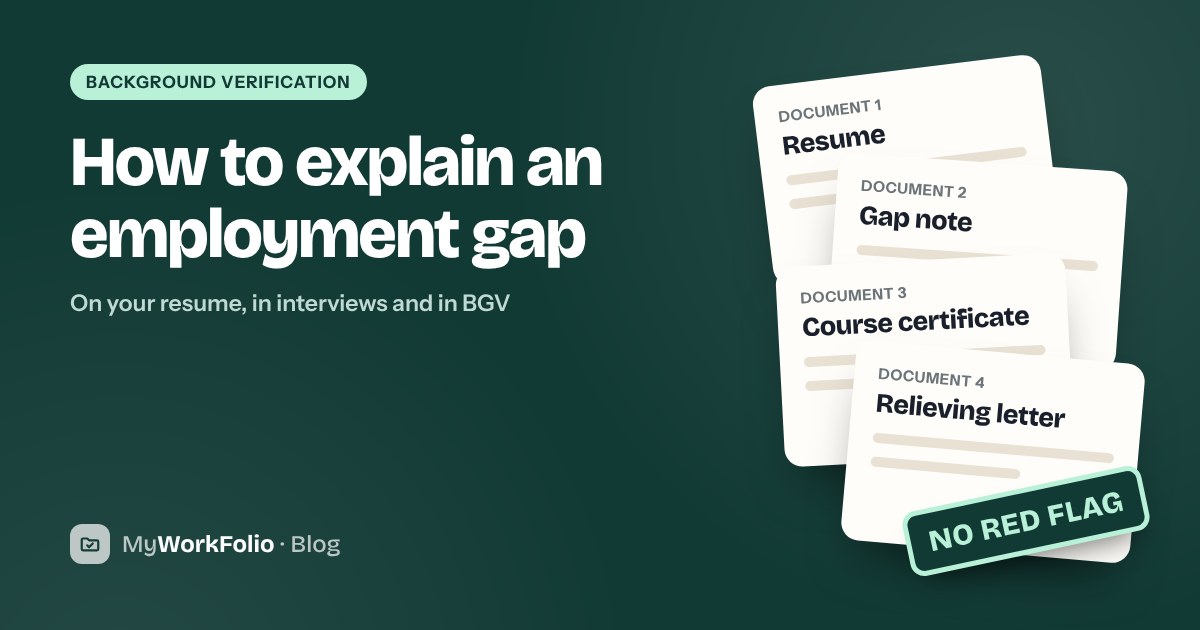
A gap is easy to explain when you can show what happened on either side of it: your relieving letter from the last job, the certificate from the course you finished, and your offer letter for the next role.
MyWorkFolio keeps these in one private vault, sorted by year and employer, so your timeline and your proof always match.
Bottom line
A gap is not a red flag. A hidden or vague gap is. Label it on your resume, declare it in your BGV form, have a 30-second answer ready, and show what you did with the time.
Frequently asked questions
Does an employment gap affect background verification?
A disclosed gap usually does not. Problems come from gaps that are hidden or that do not match your PF history and letters. Mention the gap in your BGV form with a one-line reason.
How do I explain a gap after being laid off?
State it plainly and briefly: your role was part of a layoff, then say what you did during the search, such as courses, freelance work or projects, and why you are excited about this role. Layoffs are common and most interviewers do not hold them against you.
How long a gap is too long?
There is no fixed limit. What matters more is whether you can explain it simply and show you kept your skills current. For long gaps, recent courses, projects or freelance work help a lot.
Should I show a career break on my resume?
Yes, briefly. A one-line entry such as 'Career break: higher studies' or 'Career break: family care' is better than leaving an unexplained hole in your dates.