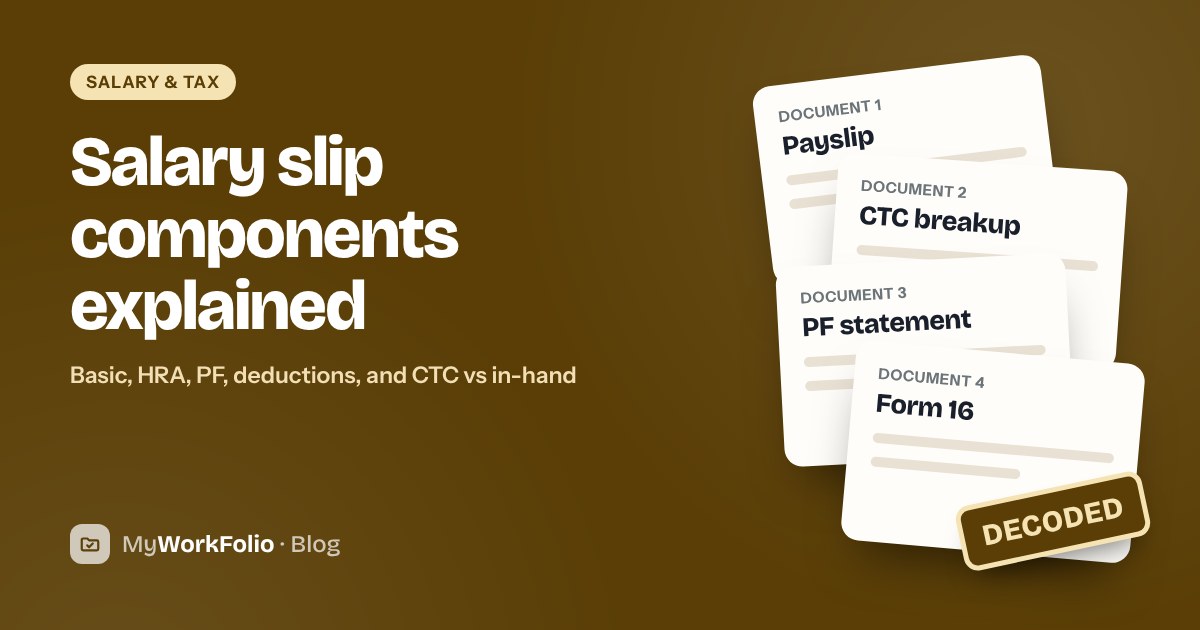
Salary slip components explained: basic, HRA, PF, allowances and deductions
Every line on an Indian salary slip explained: basic pay, HRA, special allowance, PF, professional tax and TDS. Plus CTC vs in-hand salary, and what the new labour codes' 50% wage rule means for your pay.
Your offer said one number. Your bank account shows a smaller one. The difference lives on your salary slip, in a dozen lines most people never read.
Here is what each one means, in plain language.
A typical Indian salary slip
| Earnings | Deductions |
|---|---|
| Basic salary | Employee PF |
| House rent allowance (HRA) | Professional tax |
| Special allowance | Income tax (TDS) |
| Conveyance / other allowances | Other deductions (loans, canteen, insurance top-ups) |
| Bonus or incentives (when paid) | |
| Gross salary | Total deductions |
| Net pay (in-hand) |
Earnings
Basic salary. The core of your pay. Many other things are calculated from it, including PF and, usually, gratuity.
HRA (house rent allowance). Meant to cover rent. If you pay rent and choose the old tax regime, part of HRA can be tax exempt. Under the new regime, which is the default for most salaried people, the HRA exemption is not available.
Special allowance. A flexible bucket that balances your CTC. It is fully taxable.
Other allowances. Conveyance, meal, phone and internet, books and so on. Tax treatment varies.
Bonus and variable pay. Paid when due, often quarterly or annually. It appears on the payslip only in the month it is paid.
Deductions
Employee PF. Usually 12% of your PF wages (basic plus dearness allowance), with your employer contributing a matching amount on top. It goes to your EPF account, which you can see on the EPFO member portal using your UAN.
Professional tax. A small state tax on employment. It varies by state, is capped at ₹2,500 a year, and some states do not levy it at all.
Income tax (TDS). Your employer deducts tax every month based on your projected annual income and the declarations you made. At year end it is summarised in your Form 16. From tax year 2026-27, Form 16 is replaced by Form 130 under the new Income-tax Act; see our Form 16 guide.
CTC vs in-hand salary
Your CTC (cost to company) includes things that never hit your bank account each month:
- Employer PF contribution
- Gratuity provision
- Insurance premiums paid by the company
- Variable pay that depends on performance
So the monthly in-hand is roughly: (CTC minus employer PF, gratuity, insurance and variable pay) ÷ 12, minus employee PF, professional tax and TDS.
This is why you should always ask for a CTC breakup before accepting an offer. Here is what else to check in your offer letter and appointment letter.
The new labour codes: the 50% wage rule
The four labour codes came into force on 21 November 2025, and one change affects salary structures directly.
Under the Code on Wages, "wages" includes basic pay and dearness allowance, while items like HRA and conveyance are excluded. But if the excluded components add up to more than 50% of your total remuneration, the excess is added back to "wages". That higher wage base can then change how PF and gratuity are calculated. This explainer on the 50% wage rule covers the detail.
What it means for you:
- It is not a flat rule that basic must be 50% of CTC.
- Some employers are restructuring salaries, often raising basic. That can increase PF and gratuity contributions and may lower monthly in-hand pay slightly, depending on how your CTC is restructured.
- If your structure changes, compare your old and new payslips line by line and ask HR to explain any difference.
Why you should keep every payslip
Payslips get asked for far more often than people expect:
- New jobs usually ask for the last three months. See the full list of documents required for joining a new job.
- Home loans and personal loans need recent salary proof.
- Visa applications and rental agreements often ask for them.
- Tax filing without Form 16 relies on payslips plus Form 26AS and AIS on the income tax e-filing portal.
Most company HR portals stop working on your last day. Download every payslip before then.
Bottom line
Your payslip tells you where every rupee of your CTC goes. Learn the six or seven main lines, ask for a breakup before you sign any offer, watch for restructuring under the new wage rules, and keep every payslip you ever receive.
MyWorkFolio sorts your payslips by employer and month, and shows which months are missing, so "send your last three payslips" takes seconds instead of a Gmail search.
Frequently asked questions
What is the difference between CTC and in-hand salary?
CTC is everything the company spends on you in a year, including employer PF, gratuity, insurance and variable pay. In-hand salary is what reaches your bank account each month after deductions like employee PF, professional tax and TDS.
How much PF is deducted from salary?
The standard employee contribution is 12% of your PF wages (basic plus dearness allowance), and the employer contributes a matching amount, part of which goes to the pension scheme. Some employers calculate it on a capped wage, so check your payslip.
Does basic salary have to be 50% of CTC now?
Not exactly. Under the Code on Wages, if excluded allowances exceed 50% of your total remuneration, the excess is added back to 'wages' for calculating benefits like PF and gratuity. Many employers are restructuring pay as a result, but it is not a flat rule that basic must be 50% of CTC.
This article is general information, not legal or tax advice. Rules change, so check the official sources linked above for your situation.